
Breastfeeding Tips & Tricks
Learn from the experts at Birth HQ
Breastfeeding is a rewarding experience for both mother and baby. There is an abundance of evidence that tells us it is best for baby and mum; however, breastfeeding may not always proceed as planned. For first-time parents, the early days are a time for learning and exploring what is best for us and our families and breastfeeding can sometimes pose challenges for mums. With patience and the right support, if you want to breastfeed your baby you can learn how.
Related products
Where to get real help
Before anything else, the most useful thing on this page. Breastfeeding is a learned skill for both of you, and written advice only goes so far. If it is not going well, get someone to watch a feed in person.
Your midwife or maternal child health nurse can do this. So can a lactation consultant. The Australian Breastfeeding Association runs a national helpline staffed by trained counsellors. Asking early is far easier than pushing through, and most problems are much more fixable than they feel at the time.
Set yourself up before you start
Most early feeding difficulty is a positioning problem rather than a supply problem, and positioning starts with your own body.
Sit somewhere with back support and arms you can rest on, at a height where your forearms are supported rather than held up. Bring your baby to you rather than leaning down to your baby, since leaning forward for twenty minutes is what causes the neck and shoulder pain that so many new parents describe.
Have everything within reach before you begin, because you will not want to get up. Water, a snack, your phone, a muslin. Feeds are longer than people expect in the early weeks.
Why the chair matters more than it sounds
You may feed eight or more times a day in the first months, often for half an hour or longer. That is a lot of hours in one seat.
Armrest height is the measurement that matters most. Your forearms need to rest at the height where your baby feeds, with your shoulders relaxed rather than shrugged or holding weight. A footstool changes your hip angle and takes load off your lower back.
The same thinking applies at the next stage, when feeding moves to the table. Our guide on what to look for when buying a high chair covers seat height, harness and stability.
What to expect in the early weeks
Newborns feed often, frequently every two to three hours and sometimes more, including through the night. Cluster feeding in the late afternoon and evening is normal and is not a sign that anything is wrong.
The signs to watch are the useful ones. Wet nappies, weight gain tracked by your health professional, and a baby who settles after most feeds. Those tell you more than the length of a feed or the gap between them.
Some discomfort in the first days is common. Ongoing pain is not, and it is the clearest signal to get someone to check a feed rather than to persist.
Bottle feeding and combination feeding
Plenty of families bottle feed, express, or do a combination, for all sorts of reasons. The practical set up is the same. Support your back and arms, hold your baby close and fairly upright, and pace the feed rather than rushing it.
Whatever the mix, it is worth saying plainly that a fed baby and a well parent is the goal, and that the right approach is the one that works for your family.
Moving on to solids
Somewhere around six months feeding starts to change again, and the chair changes with it. When you reach that point, you can compare the current range of high chairs and see what suits your table and your kitchen.
Night feeds
Night feeds are part of normal newborn feeding rather than a problem to solve. Babies wake to feed because they need to, and that continues for months rather than weeks for most families.
A few things make them easier. Keep the light low and the room quiet, and avoid conversation or play, so the difference between night and day is clear. Have everything you need set up before you go to bed rather than assembling it at two in the morning. Feed somewhere you can be comfortable and supported rather than propped up in bed, which is where a lot of neck and back pain starts.
If you are falling asleep during night feeds, that is worth planning around rather than ignoring. Feeding in a chair with arms and a footstool is safer than feeding somewhere you might doze off with your baby on a soft surface.
Common early worries
Almost every new parent asks the same handful of questions. Is my baby getting enough. Why do they want to feed again so soon. Why is the evening so much harder than the morning.
Frequent feeding, particularly clustered in the late afternoon and evening, is normal and is not usually a sign of low supply. The useful measures are wet nappies, weight gain tracked by your health professional, and a baby who is generally settling after feeds. If any of those are not tracking, that is the point to get help rather than to wait it out.
-
Sale!
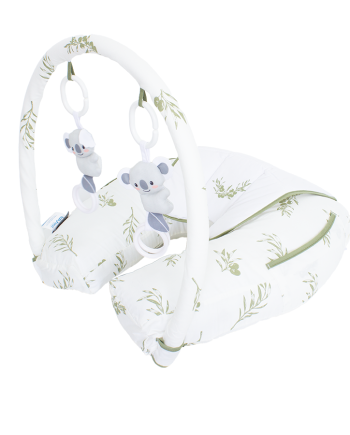
Nursing Pillow With Toy Bar
Price range: $79.95 through $94.95 Select options This product has multiple variants. The options may be chosen on the product page -
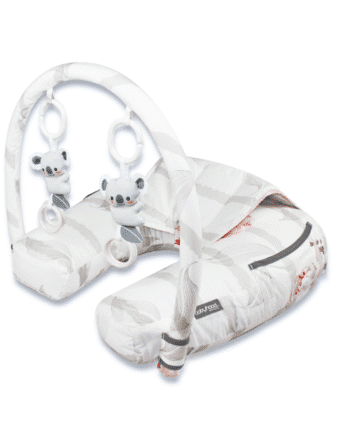
Organic Nursing Pillow with Toybar
$119.00 Select options This product has multiple variants. The options may be chosen on the product page