Co Sleeper Bassinet
A co sleeper bassinet puts your baby within arm’s reach of your bed, on their own firm mattress, behind a side that drops down when you want to reach in. It is the arrangement most Australian families land on for the first few months, and it is the one that safe sleep guidance points to. The babyhood range covers two: the Co Sleeper Cradle and the Co Sleeper Cradle Air, both height adjustable, both with a quilted Breathe Eze mattress, and both made to EN 1130.
What a bedside bassinet actually does
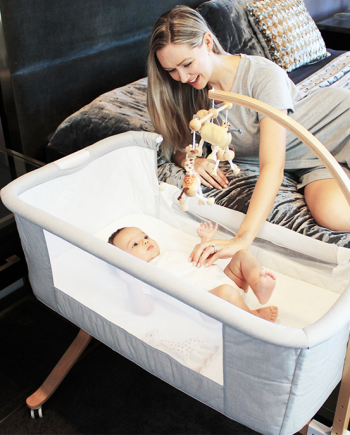
A bedside bassinet, also called a bedside sleeper, sits flush against your bed with the drop side lowered, so your baby is at your level and within reach on a separate firm surface. Put the rail back up and the same bedside sleeper works as a standalone bassinet.
That is the whole idea. A bedside bassinet gives you the proximity that makes night feeds and settling easier without sharing a sleep surface, which is what safe sleep guidance in Australia asks families to avoid. Red Nose recommends your baby sleeps in their own safe sleep space in your room for the first six to twelve months, and a bedside sleeper is the most straightforward way for most Australian families to manage it.
The mechanics matter. Safety straps hold the frame against your bed base so a gap cannot open up overnight. Height adjustable legs let the mattress sit level with yours rather than high above it or low beneath it. Both of ours use European beech legs that support the frame at four settings between 39 and 59cm depending on whether the castors are on, and both give your baby a firm quilted mattress with even support from head to toe rather than a fabric sling.
The co sleeper bassinet range
Kaylula Co Sleeper Cradle
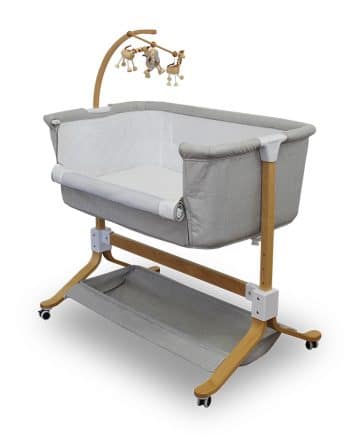
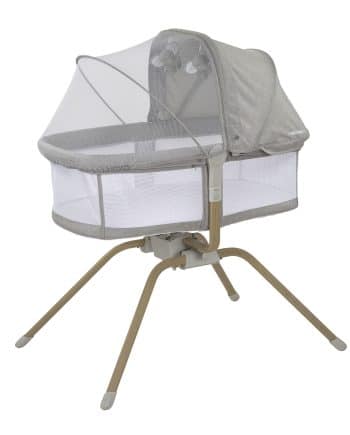
A nursery cradle, a bedside sleeper and a wheeled bassinet in one frame. The drop side adjusts, mesh panels keep airflow and visibility high, and the legs are height adjustable European beech. It comes with a quilted Breathe Eze fibre mattress at 480 by 880 by 40mm to support your baby, safety straps for your bed base, lockable wheels, a storage basket and a removable toy bar. Assembled it is W58 by L96 by up to H81cm, or 85cm on the castors. Newborn to 9kg or until your baby sits upright. EN 1130-1 and EN 1130-2.
Co Sleeper Cradle Air
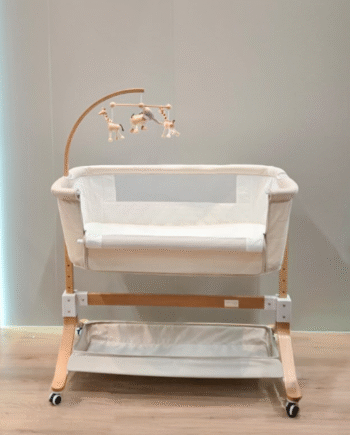
The same bedside sleeper design with full breathable mesh panels instead of quilted walls, which is the one to choose if airflow is your priority or if you are heading into a warm Australian summer. Adjustable drop side, height adjustable beech legs, safety straps, a quilted Breathe Eze mattress at 480 by 850 by 40mm to support your baby, washable fabrics throughout, optional lockable wheels. Assembled W58 by L96 by H66 to 81cm. Newborn to 9kg or sitting upright. EN 1130-1 and EN 1130-2.
Rocking legs
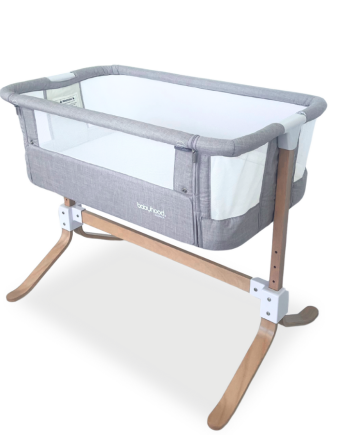
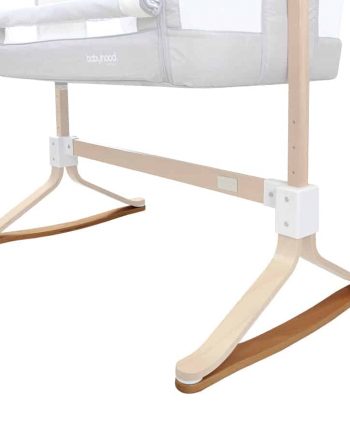
An accessory rather than a bassinet. European beech legs that swap onto the Co Sleeper Cradle in seconds with no tools, so you can rock your baby gently in the standalone position. The angle is designed to reduce the risk of tipping. Sold separately, and worth adding if you have a baby who settles better with motion.
Co sleeper bassinet or standalone bassinet?
A standalone bassinet is simpler and usually cheaper. A co sleeper bassinet does both jobs: rail down for the bedside months, rail up for the rest. If you are recovering from a caesarean, if you are feeding overnight, or if you simply want to hear your baby’s breathing, the bedside bassinet earns the price difference. It also takes the strain off your back at 2am, which is real support in the first weeks. If your baby will be in their own room from the start, a standalone is enough.
Two other things families weigh up. A co sleeper bassinet is heavier and wider than a standalone bassinet, so measure the space beside your bed before you order. And check your bed height, because the whole thing only works if the two mattresses line up. Families with a high bed frame or a low platform base should measure twice: the four settings cover a lot, but not everything.
Care and cleaning
Both products are built to be cleaned. The fabrics and the mattress cover are washable, and the beech frame takes a damp cloth and a mild detergent. Wipe the frame dry rather than leaving it wet. The mesh panels need nothing beyond a light vacuum now and then.
The care that matters most is the check you do every few weeks: straps still tight, legs still locked at the same height, mattress still firm and flat with no dip. That takes a minute and it is the difference between a bedside sleeper that stays safe and one that quietly drifts out of alignment.
Support after you buy
Both cradles carry a six month manufacturer’s fault warranty from the date of purchase, so there is support behind the product if something is wrong out of the box. Keep your receipt.
If you want support choosing between the two, or you are not sure the straps will suit an unusual bed base, ask us before you order rather than after. A co sleeper bassinet is the kind of thing that is easier to get right the first time than to send back.
Safe sleep with a bedside bassinet
None of this is complicated, and it is the same safe sleeping advice you will hear at your first appointment.
- Your baby sleeps on their back, on the firm flat mattress that came with the bassinet, every time.
- Use the safety straps. A bedside bassinet that is not strapped to the bed base can drift and open a gap.
- Match the heights. The bassinet mattress should sit level with your mattress, with no step between them.
- Keep the sleep space clear. No pillows, no bumpers, no support wedges, no toys, and take the toy bar off before sleep.
- Stop at 9kg or the day your baby pushes up and sits, whichever comes first.
- Nothing soft should sit in the gap between the bassinet and your bed. If a gap exists, the straps are not tight enough.
Price, and what you are paying for
The price of a co sleeper bassinet sits above a plain bassinet because you are buying an adjustable frame, a drop side mechanism and a set of height settings rather than a fixed basket. Whether that price is worth it depends on how many months you will use the bedside position. Most families get four to six months out of it, then keep using the same frame as a standalone bassinet or a wheeled cradle until the weight limit.
The price of each model is on the tile above, and the rocking legs carry their own price. It is also a common group gift: a co sleeper bassinet is the sort of gift several people go in on together, and it is a more useful gift than another pile of 0000 jumpsuits. A bedside bassinet is also an easy gift to ask for, because nobody has to guess whether you will use it. If a baby shower is coming up, name which of the two products you want, because they look similar in photos and are not interchangeable.
Co sleeper bassinet FAQs
Are co-sleeper bassinets safe for newborns?
Yes, used as designed. The baby sleeps on their own firm flat mattress, strapped level with your bed, on their back, with a clear sleep space. That is a safe sleep setup by every Australian guideline. What is not safe is sharing a sleep surface, and a bedside bassinet exists precisely so you do not have to. The safe sleep rules are the same whether the rail is up or down.
Is a co-sleeper bassinet worth it?
If you are feeding overnight or recovering from a birth that makes getting out of bed hard, most families say yes. It is easier to settle a baby you can reach. If your baby is going straight into their own room, a standalone bassinet does the job for less.
Is co-sleeping recommended in Australia?
Sharing a sleep surface is not recommended. Sharing a room is. Red Nose advises that babies sleep in their own safe sleep space in the same room as a caregiver for the first six to twelve months, which is exactly what a bedside sleeper provides. That is the safe sleeping position most Australian families are working from, and a bedside bassinet is built around it.
Are bassinet and co-sleeper the same?
Not quite. Every co sleeper bassinet can work as a regular bassinet, but not every bassinet can attach to your bed. The drop side, the safety straps and the height adjustment are what make one a co sleeper.
Which one should you buy?
Take the Cradle Air if breathable mesh matters most to you. Take the standard Co Sleeper Cradle if you prefer quilted walls and want the storage basket. Add the rocking legs either way if you have a baby who needs motion to settle. Both products end at the same weight, so this is a comfort and airflow decision rather than a longevity one.
If you want help deciding, get in touch. If you are already thinking past the bassinet months, the Scandi Cots range is where most families go next. Scandi Cots share the same pale timber look, so a bedside sleeper and a Scandi cot sit together in a room without clashing.