
How To Latch Baby Q&A With The Experts
Breastfeeding is a rewarding experience for both mother and baby. There is an abundance of evidence that tells us it is best for baby and mum; however, breastfeeding may not always proceed as planned. For first-time parents, the early days are a time for learning and exploring what is best for us and our families and breastfeeding can sometimes pose challenges for mums. With patience and the right support, if you want to breastfeed your baby you can learn how.
Related products
Get a feed watched in person
Latching is one of those things that is difficult to learn from a description and straightforward to correct when someone experienced watches you do it. If feeding hurts, or your baby is not settling after feeds, that is the point to ask rather than to persist.
Your midwife or maternal child health nurse can watch a feed. So can a lactation consultant. The Australian Breastfeeding Association runs a national helpline staffed by trained counsellors. None of this means anything has gone wrong. Most feeding problems are positioning problems, and most are fixed quickly once someone has looked.
What a good latch tends to feel like
A comfortable latch usually feels like a strong tug or drawing sensation rather than a pinch. There may be some tenderness in the first few days, particularly at the start of a feed, and that generally eases.
Sharp pain, pain that continues through the whole feed, or pain that gets worse over days is a signal rather than something to tolerate. So is a nipple that comes out flattened, wedge shaped or with a visible line across it. Cracked or bleeding skin is a clear sign to get help now rather than later.
What people notice when it is working
Rather than checking a list mid feed, most parents find it easier to notice a few broad things. Your baby takes a deep mouthful rather than sitting on the tip. Their chin is against you and their nose is clear. You can see and hear swallowing once your milk lets down, in a rhythm that slows as the feed goes on. Your baby comes off relaxed rather than frantic.
Over the day, wet nappies and weight gain tracked by your health professional tell you more than any single feed does.
Position yourself first
The most common cause of a shallow latch is the adult being in an awkward position. If you are hunched forward, holding your baby’s weight with your arms, or twisting to one side, the angle at the breast is wrong before your baby has done anything.
Sit with your back supported and your forearms resting rather than raised. Bring your baby to you rather than leaning down to them. Support their whole body so they are not hanging from their head, and keep them turned in towards you rather than flat on their back with their head rotated.
There is no single correct hold. Different positions suit different bodies, different babies and different stages, and it is worth trying more than one.
Why the chair matters
You will feed eight or more times a day in the early months, often for half an hour or more. Armrest height decides whether your forearms are supported or whether you are holding your baby up with your own muscles for the whole feed, which is where neck and shoulder pain comes from. A footstool changes your hip angle and takes load off your lower back.
The same principle applies when feeding moves to the table later on. Our guide on what to look for when buying a high chair covers seat height, harness and stability, and you can compare the current range of high chairs when you reach that stage.
If it is still not working
Persistent pain, a baby who will not stay on, or slow weight gain all warrant a proper assessment rather than another week of trying. There can be physical reasons on either side, and they are worth identifying rather than working around.
Ask your midwife, maternal child health nurse, GP or a lactation consultant. Getting help early is easier for both of you than getting it late.
Feeding in the first days
The first few days look different from what comes after, and knowing that saves a lot of worry. Colostrum comes in small volumes, so early feeds are short and frequent rather than long. Your baby’s stomach is very small at this stage and is meant to be filled often.
Frequent feeding in this period is doing a job. It is what signals your body to increase supply, so feeding on demand rather than to a schedule is generally what is recommended in the early weeks.
Looking after yourself while you feed
Keep water within reach and drink at every feed, because thirst arrives suddenly and getting up is the last thing you will want to do. Eat something you can hold in one hand.
Change position between feeds rather than always using the same side and the same hold, which spreads the load on your neck, shoulders and back. If you are getting sore in the same spot every day, that is worth mentioning to your health professional too, since it usually points at the set up rather than at you.
-
Sale!
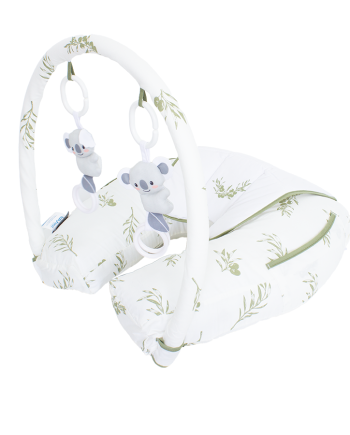
Nursing Pillow With Toy Bar
Price range: $79.95 through $94.95 Select options This product has multiple variants. The options may be chosen on the product page -
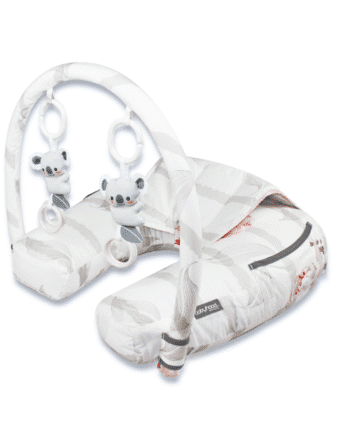
Organic Nursing Pillow with Toybar
$119.00 Select options This product has multiple variants. The options may be chosen on the product page