
Which Glider Chair is Right for You?
Our range of feeding gliders offer different features, specific to your needs and preferences. Watch the video to see which chair suits your budget, body shape and ergonomic needs.
Related products
What is a glider chair?
A glider chair is a nursery chair that moves forward and back along a fixed horizontal track built into its base. The seat stays level as it travels, so the motion is smooth and quiet rather than the tipping motion of a traditional rocker.
That difference matters more than it sounds when you are feeding a baby at three in the morning. The movement is easy to keep going with very little effort, it does not require you to shift your weight, and it does not knock against a skirting board or creak on floorboards.
Glider, rocker or recliner, and how they differ
The three get used interchangeably in conversation but they behave differently.
A rocker sits on curved runners and tips through an arc. The seat angle changes as you move, so your baby’s position shifts slightly with every rock. Rockers are usually the cheapest of the three and take up the least room, but the curved runners can walk across a hard floor and are easy to catch a toe under.
A glider travels along a level track, so your body and your baby stay at the same angle throughout. It needs clearance behind it for the travel, so it does not sit flush against a wall.
A recliner leans back to a fixed set of positions and generally does not move otherwise. It is the most comfortable for sitting still over a long stretch, and the least useful for settling a baby who responds to motion.
Most nursery chairs sold in Australia are gliders, and many combine the glider base with a recline function so you get both.
Why the ottoman matters more than people expect
Every glider chair in the babyhood range comes with a matching ottoman, and it is not a decorative extra. Raising your feet changes the angle of your hips and lower back, which is what takes the strain off while you are holding a baby in one position for twenty minutes or more.
It matters most in the early weeks, and it matters a great deal if you are recovering from a caesarean, when getting in and out of a low seat unaided is the difficult part. A gliding ottoman that moves with the chair keeps your feet supported through the motion rather than sliding off.
What to check before you buy
Sit in it before you commit if you possibly can, and take these four things into account.
Arm height is the one most people miss. Your forearms need to rest on the arms at the height where your baby feeds, without you hunching your shoulders or holding them up. Arms that are too low are the most common cause of neck and shoulder pain in a feeding chair.
Seat depth needs to suit your height, so that your back reaches the backrest while your feet still touch the floor. Shorter parents often find a deep seat leaves them perched forward with no lumbar support.
Fabric should be something you can clean. Nursery chairs get milk, and later they get everything else. Check whether the cover can be spot cleaned and whether a care kit is available.
Footprint and clearance matter because a glider needs room to travel. Measure the space behind the chair as well as the floor area, and check the ottoman has somewhere to live.
Do you actually need one?
It is a fair question, and it is worth answering honestly before you spend the money. If you have a comfortable armchair at the right height with arms you can rest on, you may not need a dedicated chair at all. If you do not, feeding several times a night in a chair that puts your shoulders and lower back in the wrong position adds up quickly over the first year.
Our post on whether you do you really need a nursing chair goes through that decision, including what second time parents say they would do differently.
If you decide it is worth it, you can compare the current range of nursing chairs and see which model suits your body and your room.
Where to put it in the room
A glider needs clearance behind it to travel, so it does not sit flush against a wall the way an armchair does. Leave a gap and check the ottoman still has somewhere to sit when it is not in use.
Think about what you need within reach while you are feeding, because once you are settled with a baby you will not want to get up. A small side table for a glass of water and your phone, a lamp you can turn on without standing, and somewhere to put a muslin all save you more trouble than they sound like they would.
Position matters for the room as well. Near the cot is convenient for transferring a sleeping baby, but not so close that the chair blocks the base drop or the cot side. By a window is pleasant during the day, though you may want a blind if you are settling a baby for a nap.
Looking after the fabric
Nursery chairs take more punishment than most furniture in the house. Check what the manufacturer recommends for the specific fabric before you use any cleaning product on it, since boucle, woven fabric and vinyl all behave differently. Dealing with a spill straight away is far more effective than treating a set stain later, and a care kit is worth having on hand before you need it rather than after.
-
Sale!
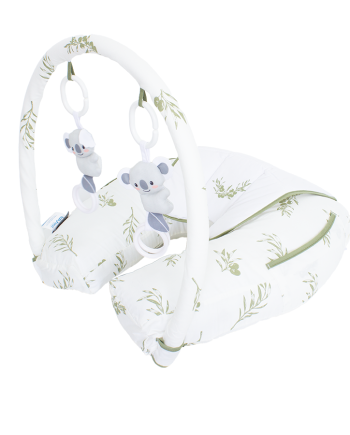
Nursing Pillow With Toy Bar
Price range: $79.95 through $94.95 Select options This product has multiple variants. The options may be chosen on the product page -
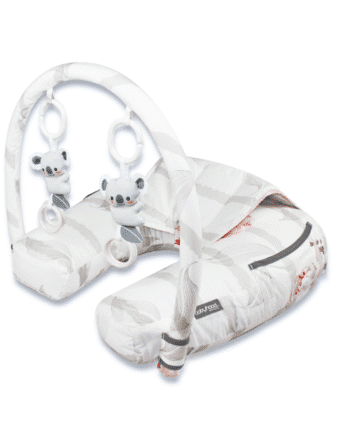
Organic Nursing Pillow with Toybar
$119.00 Select options This product has multiple variants. The options may be chosen on the product page